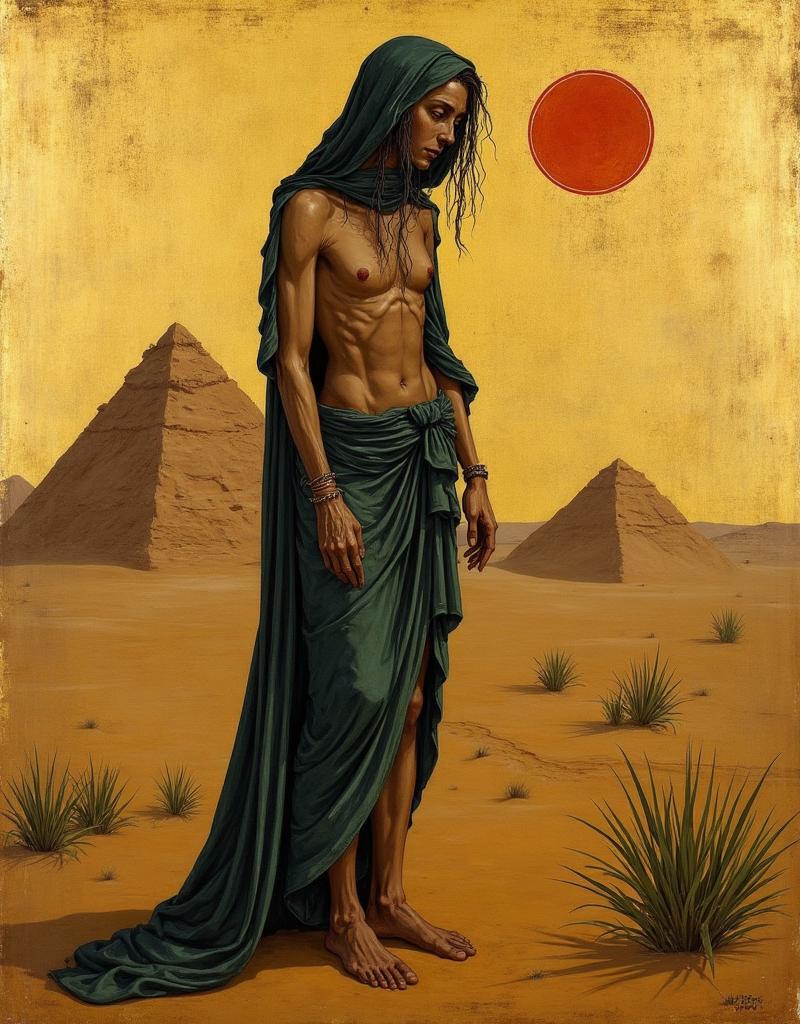
Saint Mary of Egypt
The Repentant
Life & Biography
Mary left her family in Egypt at the age of twelve and traveled to Alexandria, where she lived a dissolute life for seventeen years. She joined a group of pilgrims to Jerusalem not out of piety but seeking new pleasures.
At the Church of the Holy Sepulchre, an invisible force prevented her from entering. Overcome with remorse, she prayed before an icon of the Theotokos and heard a voice telling her to cross the Jordan to find rest. She received communion at the monastery of Saint John the Baptist on the Jordan and then crossed into the wilderness.
For forty-seven years she lived alone in the desert beyond the Jordan, eating only what she could find, enduring extreme hardship and spiritual struggle. Near the end of her life, the monk Zosimas discovered her. He found her levitating in prayer, walking on water, and possessing knowledge of Scripture she had never read. She asked him to bring her communion the following year, and when he returned, he found her body lying peacefully in death.
Legacy & Impact on Orthodoxy
Saint Mary's story is the supreme example of repentance in the Orthodox tradition. Her Life is read in its entirety during the fifth week of Great Lent at the service of the Great Canon of Saint Andrew of Crete, reminding every Christian that no sinner is beyond the reach of God's mercy. Her story has inspired countless penitents throughout the centuries.
Key Quotes
"Do not cross the Jordan, Zosimas! Do not cross the Jordan!
— Life of Saint Mary of Egypt
Liturgical Hymns
Troparion
In thee, O Mother, was exactly preserved what was according to the divine image. For thou didst take the Cross and follow Christ, and by thy life didst teach us to ignore the flesh, for it passeth away, but to care for the soul, since it is immortal. Therefore, O holy Mary, thy spirit rejoiceth with the angels.