Photo: Wikimedia Commons / Public Domain
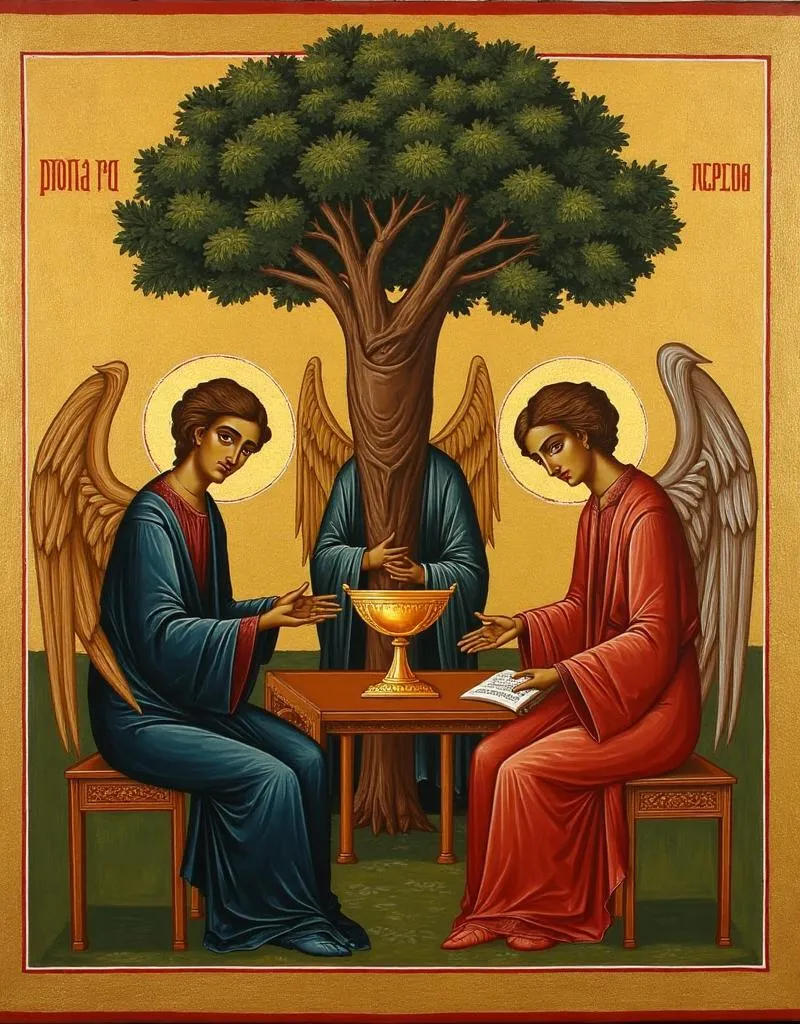
The Holy Trinity (Hospitality of Abraham)
Ἁγία Τριάς
Святая Троица
Tretyakov Gallery, Moscow
About This Icon
Andrei Rublev's Trinity (c. 1411–1427) is arguably the most famous icon ever painted. It depicts three angels seated around a table — the three visitors received by Abraham at the Oak of Mamre (Genesis 18). In Orthodox interpretation, these three angels represent the Holy Trinity.
The composition is a masterwork of circular movement. The three figures lean toward each other in a dance of love, creating a visual rhythm that draws the viewer into the communion of the Trinity. The chalice on the table suggests the Eucharist. The open space at the front of the table is an invitation — a place for the viewer to sit and join the divine feast.
Symbolism & Iconographic Elements
The Three Figures: Each angel represents a Person of the Trinity. While the identification varies among interpreters, the central figure is often seen as Christ (wearing red and blue), the left as the Father, and the right as the Holy Spirit (in green).
The Chalice: The cup on the table contains a lamb — the sacrifice of Christ. The Eucharistic reference is unmistakable.
The Open Side: The composition opens toward the viewer, creating a 'fourth place' at the table — an invitation into divine communion.
The Oak of Mamre: The tree behind the central figure symbolizes the Tree of Life.
The Rock: Behind the right figure, a rock or mountain symbolizes spiritual ascent and the dwelling place of God.
History
Painted by Andrei Rublev, a monk of the Trinity Lavra of St. Sergius near Moscow, around 1411–1427. It was created in honor of St. Sergius of Radonezh, the founder of the lavra, who dedicated his monastery to the Holy Trinity.
The icon is considered the highest expression of Russian spiritual art and was declared the model for all subsequent Trinity icons by the Stoglav Council of 1551.
Prayer
O Most Holy Trinity, have mercy on us. O Lord, cleanse us from our sins. O Master, pardon our transgressions. O Holy One, visit and heal our infirmities, for Thy name's sake.