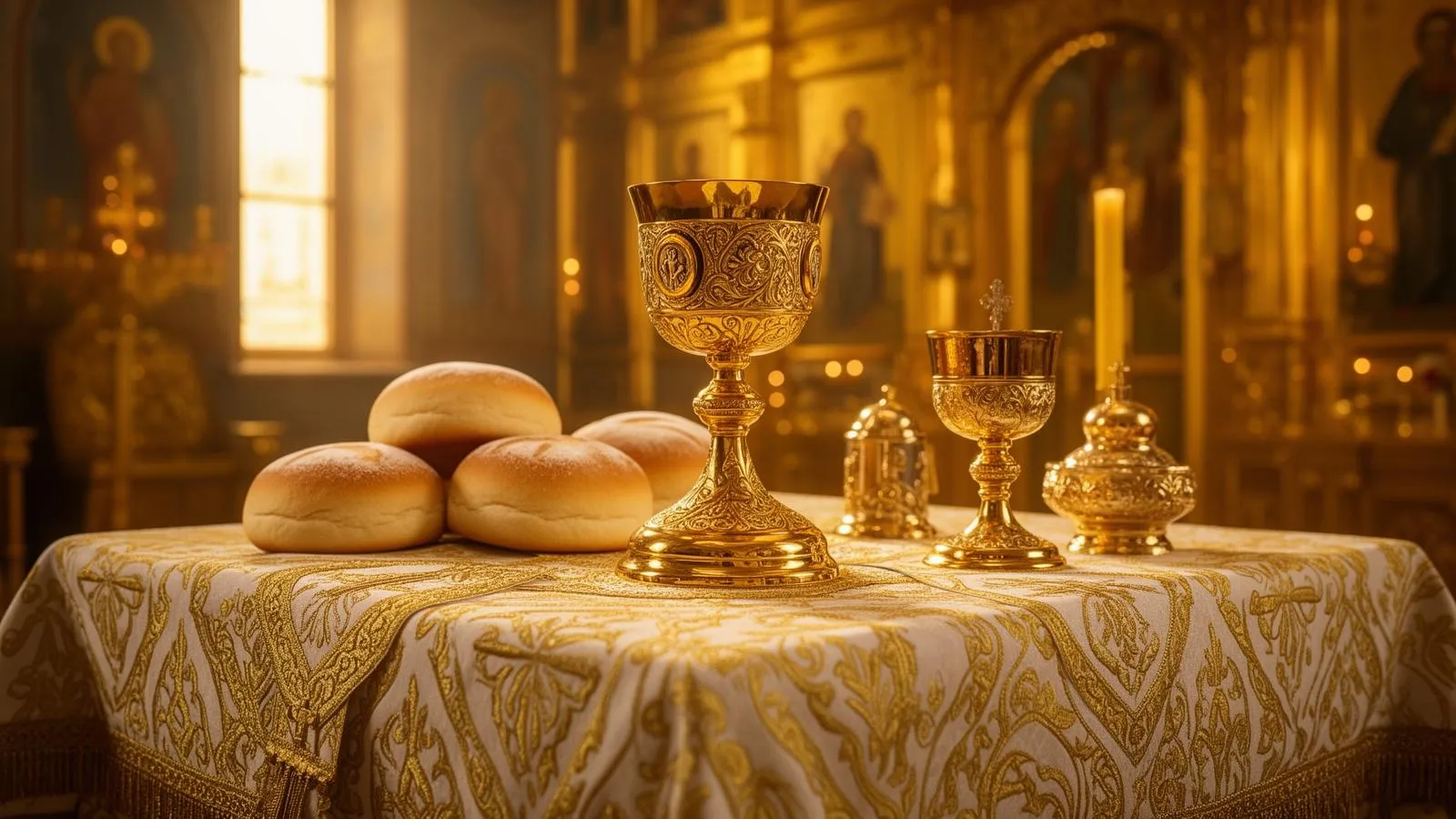
The Holy Mysteries
The Orthodox Church speaks of sacraments as "Holy Mysteries" — visible signs of invisible grace, moments where heaven touches earth through material elements: water, oil, bread, wine. While the Western Church formally lists seven sacraments, Orthodoxy recognizes that God's grace is not limited to a fixed number, though seven are traditionally enumerated.
The Seven Mysteries
1. Baptism
The entrance into the Church. Through triple immersion in water in the name of the Father, Son, and Holy Spirit, a person dies to sin and rises to new life in Christ.
2. Chrismation
Immediately following Baptism, the newly baptized is anointed with holy chrism (oil consecrated by bishops), sealing the gift of the Holy Spirit. This is the Orthodox equivalent of Confirmation, but it is administered at Baptism regardless of age.
3. The Eucharist (Holy Communion)
The central mystery of Orthodox life. Bread and wine become the true Body and Blood of Christ. The faithful receive Communion regularly — ideally every Sunday — after preparation through fasting, prayer, and confession.
4. Confession (Repentance)
The sacrament of reconciliation, in which a person confesses sins before God in the presence of the priest, who serves as witness and guide. Absolution is granted, and spiritual counsel is given.
5. Holy Unction (Anointing of the Sick)
Anointing with blessed oil for the healing of soul and body. This is not reserved for the dying — it is offered to anyone who is ill, and a general anointing service is held during Holy Week for all the faithful.
6. Marriage (Holy Matrimony)
The crowning of a man and woman as king and queen of a new domestic church. The Orthodox wedding service is rich with symbolism — the crowns, the common cup, the ceremonial walk around the Gospel.
7. Holy Orders (Ordination)
The sacrament by which men are ordained as deacons, priests, or bishops to serve the Church in ministry.
The Orthodox Church does not view the sacraments as magical rituals but as genuine encounters with God. The grace they confer requires the recipient's faith, repentance, and cooperation.
Senior Writer
Maria is a lifelong Orthodox Christian and writer covering faith, liturgical life, and the journey of seekers exploring the ancient Church. She holds a degree in theology from St. Vladimir's Seminary.
Continue Reading
A Guide to Orthodox Icons: What They Are and Why They Matter
Icons are not mere decoration — they are windows into heaven. Learn the theology behind Orthodox iconography and how icons function in worship and daily life.
How to Become Orthodox Christian: A Practical Guide
Becoming Orthodox is a journey, not a transaction. This guide walks you through the process — from first visit to baptism and chrismation — with honesty and practical advice.
Understanding the Divine Liturgy: A Beginner's Guide
The Divine Liturgy is the heart of Orthodox worship. This guide walks through its structure, symbolism, and meaning so you can follow along with understanding.
Stay on the Path
Get weekly Orthodox insights, feast day guides, and parish spotlights delivered to your inbox.
No spam. Unsubscribe anytime.