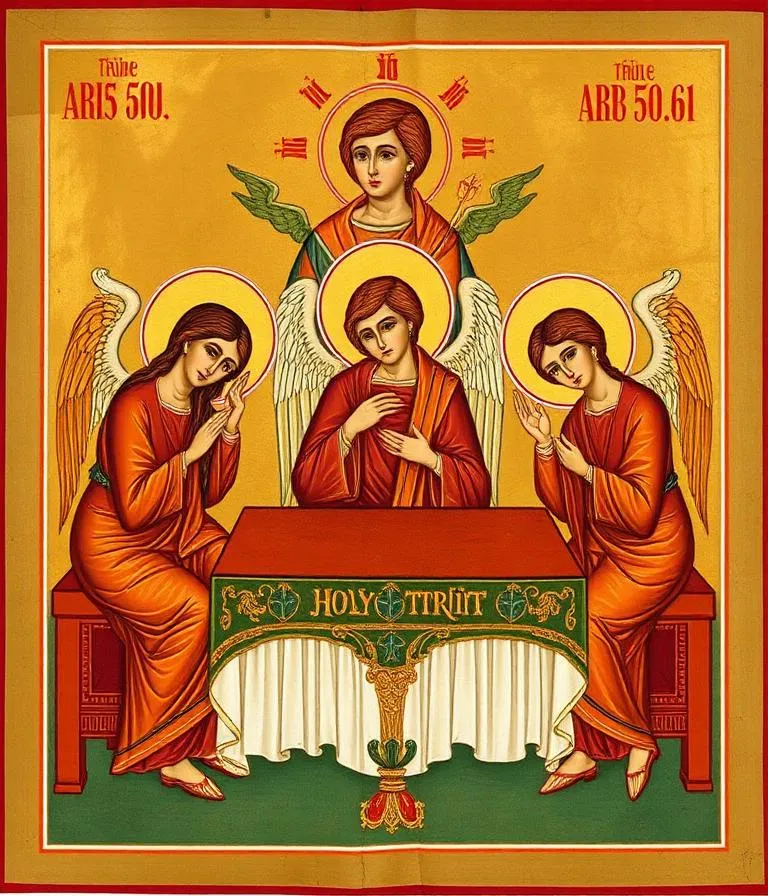
The Nicene Creed: Our Common Confession
The Nicene Creed is the defining statement of Orthodox Christian belief. Composed at the First Ecumenical Council in Nicaea (325 AD) and expanded at Constantinople (381 AD), it has been recited in every Divine Liturgy for over sixteen centuries. It is not a theological essay — it is a hymn of faith, spoken together by the entire congregation.
The Holy Trinity
At the heart of Orthodox theology is the mystery of the Holy Trinity — one God in three Persons: the Father, the Son, and the Holy Spirit. The Father is the eternal source; the Son is eternally begotten of the Father; the Holy Spirit eternally proceeds from the Father.
"When I say God, I mean Father, Son, and Holy Spirit — for Godhead is neither diffused beyond these, lest we introduce a multitude of gods, nor bounded short of these, lest we be condemned for poverty of Godhead."
The Orthodox Church rejected the later Western addition of the Filioque ("and the Son") to the Creed, maintaining that the Holy Spirit proceeds from the Father alone, as Christ Himself taught in John 15:26.
The Incarnation
Orthodox Christianity teaches that the eternal Son of God became fully human without ceasing to be fully divine. Jesus Christ is one Person with two natures — divine and human — united "without confusion, without change, without division, without separation," as the Council of Chalcedon (451 AD) declared.
The Incarnation is not merely a historical event. It is the hinge of all creation — the moment when God entered His own creation to heal it from within.
Salvation as Theosis
Unlike much of Western Christianity, Orthodoxy does not frame salvation primarily in legal terms (a courtroom verdict). Instead, the Orthodox understanding of salvation is theosis — divinization, union with God.
"God became man so that man might become god."
This does not mean we become God in essence. It means we are invited to share in God's divine life and energy — to be transformed by grace into the likeness of Christ. Salvation is not a one-time event but a lifelong journey of healing, growth, and communion with the living God.
The Role of Synergy
Orthodoxy teaches that salvation involves synergy — a cooperation between God's grace and human free will. God does not save us against our will, nor can we save ourselves by effort alone. He extends His hand; we choose to take it. Every prayer, every fast, every act of love is a response to divine invitation.
Scripture and Tradition
The Orthodox Church holds that divine revelation comes through both Holy Scripture and Holy Tradition — and that these are not two separate sources, but one living reality. The Scriptures were born within Tradition, written by members of the Church, canonized by the Church, and are rightly interpreted within the Church.
The Orthodox Bible includes several books (Tobit, Wisdom of Solomon, Sirach, and others) that are not found in most Protestant Bibles. These books have been read in Christian worship since the earliest centuries.
The Ecumenical Councils
Orthodox doctrine was clarified and defended through seven Ecumenical Councils held between 325 and 787 AD. These councils addressed heresies, defined the nature of Christ, affirmed the veneration of icons, and produced the Creed. The Orthodox Church regards these councils as guided by the Holy Spirit and their decisions as binding for all time.