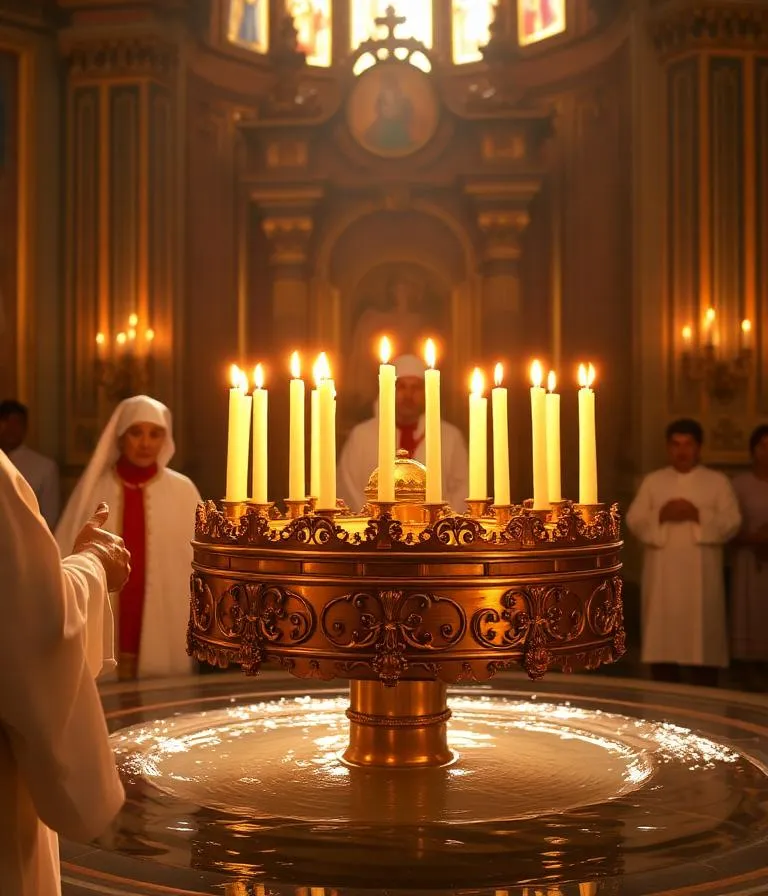
The Holy Mysteries
In Orthodox Christianity, the sacraments are called the Holy Mysteries — visible signs of invisible grace through which God sanctifies and transforms us. The Church traditionally recognizes seven principal mysteries, though the entire life of the Church is understood as sacramental.
Baptism
Baptism is the door to the Christian life. In the Orthodox Church, baptism is performed by triple immersion — the person is immersed three times in water in the name of the Father, Son, and Holy Spirit. This practice follows the ancient pattern described in the Didache (1st century) and the writings of the early Church Fathers.
Through baptism, a person dies and rises with Christ. The old self is buried in the water; a new creation emerges. Infants are baptized in the Orthodox Church because salvation is a gift of grace, not a reward for intellectual understanding.
"You were led to the holy pool of divine baptism, as Christ was carried from the Cross to the sepulchre. And each of you was asked whether you believed in the name of the Father, and of the Son, and of the Holy Spirit. And you made that saving confession, and descended three times into the water, and ascended again — symbolizing the three days of Christ's burial."
Chrismation
Immediately after baptism, the newly illumined person receives Chrismation — anointing with holy chrism (oil consecrated by a bishop). This is the Orthodox equivalent of "confirmation," but it is not delayed. The seal of the Holy Spirit is placed on the forehead, eyes, nostrils, mouth, ears, chest, hands, and feet, with the words: "The seal of the gift of the Holy Spirit. Amen."
The Eucharist
The Eucharist (Holy Communion) is the very center of Orthodox life. Orthodox Christians believe that the bread and wine truly become the Body and Blood of Christ — not symbolically, not merely spiritually, but really and truly. This transformation is effected by the Holy Spirit at the invocation (epiclesis) during the Divine Liturgy.
The Eucharist is not simply a memorial meal. It is a participation in the eternal sacrifice of Christ, the medicine of immortality, and a foretaste of the heavenly banquet. Orthodox Christians are expected to receive Communion regularly after proper preparation.
Confession
The Mystery of Confession (Repentance) is the means by which a baptized Christian who has fallen into sin is reconciled to God and the Church. The penitent confesses before God in the presence of a priest, who serves as a witness and spiritual physician — not a judge.
If you are new to Orthodoxy or haven't been to confession before, speak with your priest. He will guide you through the process with patience and compassion. There is no sin too great for God's mercy.
Marriage
Orthodox Marriage (also called "Crowning") is understood not as a contract but as the joining of two people into a small church — a domestic community of faith. The crowns placed on the couple's heads symbolize both glory and martyrdom, reflecting the self-sacrifice required in married love.
Holy Orders
Through Holy Orders, men are ordained to serve the Church as deacons, priests, or bishops. Ordination is performed by the laying on of hands by a bishop during the Divine Liturgy. The Orthodox Church ordains only men to these roles, following the unbroken practice of the apostolic Church.
Anointing of the Sick
The Mystery of Holy Unction (Anointing of the Sick) is the anointing with blessed oil for the healing of soul and body. It is administered not only to the dying but to any Christian who is ill or suffering. During Holy Week, the service of Holy Unction is offered to the entire congregation.