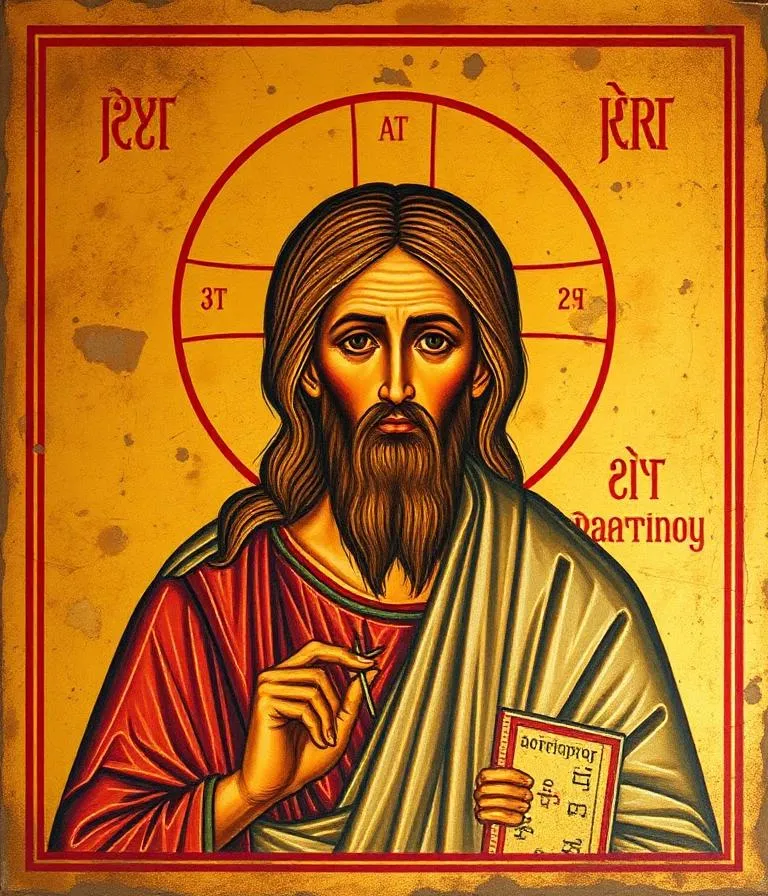
Windows Into Heaven
Orthodox icons are not merely paintings. They are theology in color — visual expressions of the faith that communicate the reality of the Incarnation. Because God became visible in the person of Jesus Christ, the Church teaches that He can be depicted in images. Icons are windows into the heavenly realm, inviting us to encounter the saints and events they portray.
The Theology of Icons
The veneration of icons is grounded in the Incarnation — the central mystery of Christianity. The argument is straightforward:
- God is invisible and cannot be depicted
- But God became visible in the flesh of Jesus Christ
- Therefore, the human face of Christ can be depicted
- And through the image, we honor the Person depicted — not the wood and paint
"Of old, God the incorporeal and uncircumscribed was not depicted at all. But now that God has appeared in the flesh and lived among men, I make an image of the God who can be seen. I do not worship matter; I worship the Creator of matter who became matter for my sake."
The Second Council of Nicaea (787 AD) definitively defended icon veneration against the iconoclasts — those who destroyed icons, claiming they were idols. The Council distinguished between latreia (worship, due to God alone) and proskynesis (veneration, given to icons, the cross, and sacred objects).
The Iconoclastic Controversy
The Iconoclasm crisis (726–843 AD) was one of the most violent upheavals in Church history. Byzantine emperors, influenced by Islamic and certain theological arguments, ordered the destruction of icons throughout the Empire. Monks and laypeople who defended icons were tortured, exiled, and killed.
The final triumph of icon veneration was celebrated on the First Sunday of Great Lent in 843 AD — a day still commemorated annually as the Sunday of Orthodoxy, when icons are processed through the church and the Synodikon of Orthodoxy is read aloud.
How Icons Are Written
Icons are not created through artistic self-expression. They are written according to strict canons — traditional rules governing proportion, color, symbolism, and composition. The iconographer prepares through prayer and fasting, understanding that the icon is a work of the Church, not of an individual artist.
Key Elements of Iconographic Style
- Gold background — represents the uncreated light of God's Kingdom
- Inverse perspective — the vanishing point is in front of the icon, drawing the viewer in
- Flat, luminous figures — the saints are depicted not as they appeared in earthly life, but as they are in the Kingdom, transfigured by divine light
- Symbolic colors — blue for divinity, red for humanity/sacrifice, white for resurrection, green for life and renewal
- No shadows — in the Kingdom of God there is no darkness
Orthodox Christians do not worship icons. They venerate them — kissing the icon, bowing before it, lighting candles — as acts of love directed to the person depicted. As St. Basil the Great taught: "The honor given to the image passes over to the prototype."
Major Types of Icons
- Christ Pantocrator — Christ as ruler of all, often in the central dome
- The Theotokos and Child — Mary holding the Christ Child, with many subtypes (Hodegetria, Eleousa, Platytera)
- Feast Icons — depicting events like the Nativity, Transfiguration, Crucifixion, and Resurrection
- Saints — individual portraits of holy men and women
- The Iconostasis — the great icon screen in every Orthodox church, arranged in a specific theological order
Living With Icons
Orthodox homes traditionally have an icon corner — a dedicated space with icons, a lampada (oil lamp), and prayer books. This is the family's place of prayer, oriented toward the east. Morning and evening prayers are offered here, and the icon corner serves as a visible reminder that the home is a small church.